

FALLAUT
Case analysis of the effects of near-border nuclear weapon deployments on the resilience of essential supply infrastructures
Due to the current geopolitical situation in Europe, the scenario of a nuclear explosion has become considerably more likely in recent years. The consequences for the affected population as well as for critical supply infrastructures and supply chains would be devastating. Such an explosion could not only occur at a greater distance from Austria, as already examined in the BMK's National Emergency Plan, but is also plausible in the immediate vicinity of Austria due to strategically relevant targets.
The project “FALLAUT” investigates the potential consequences of a hypothetical use of nuclear weapons over the NATO base in Aviano, close to the Austrian border. With the help of modern open-source computer models atmospheric transport and dispersion calculations are performed which enable a more precise analysis of the dispersion of radioactive particles. These calculations subsequently serve as input for a radiological model to estimate doses and further on relevant transport paths. The aim is to estimate the humanitarian consequences on Austria.
The focus of the study is specifically on the consequences for critical infrastructures such as the countrywide food supply or functioning of the national health service. In addition, potential effects on supply chains will be analyzed. The results of the project will help to further develop suitable emergency planning and safeguarding in order to increase the resilience against such scenarios. Additionally, the knowledge base on which consequences of nuclear weapons tests can be deduced is increased. The source term for atmospheric nuclear explosions to be developed within the project will be publicly available and can be used by others for the purpose of state-of-the-art atmospheric transport and dispersion modeling.
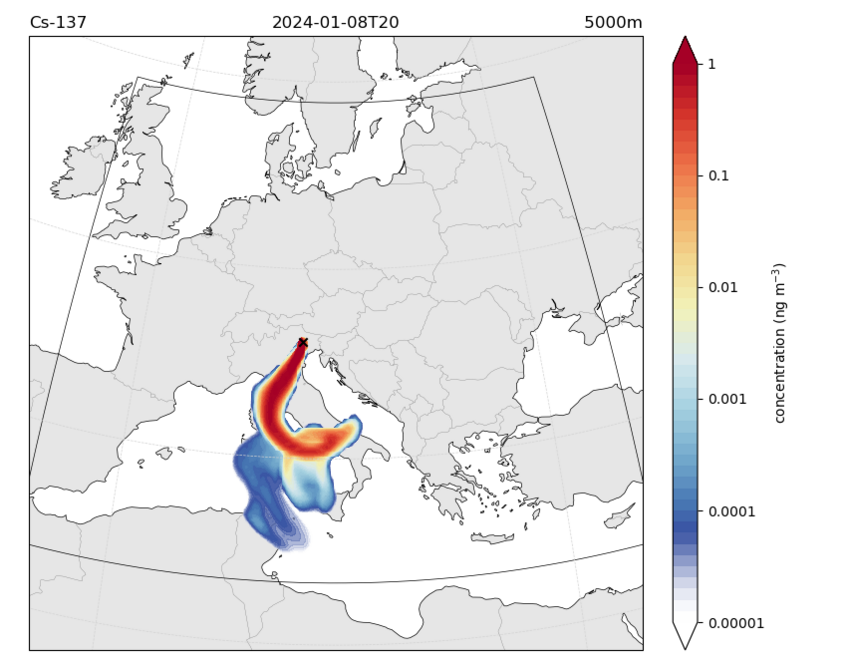
©UNIVIE Example forward simulation of CS-137 using the FLEXPART model